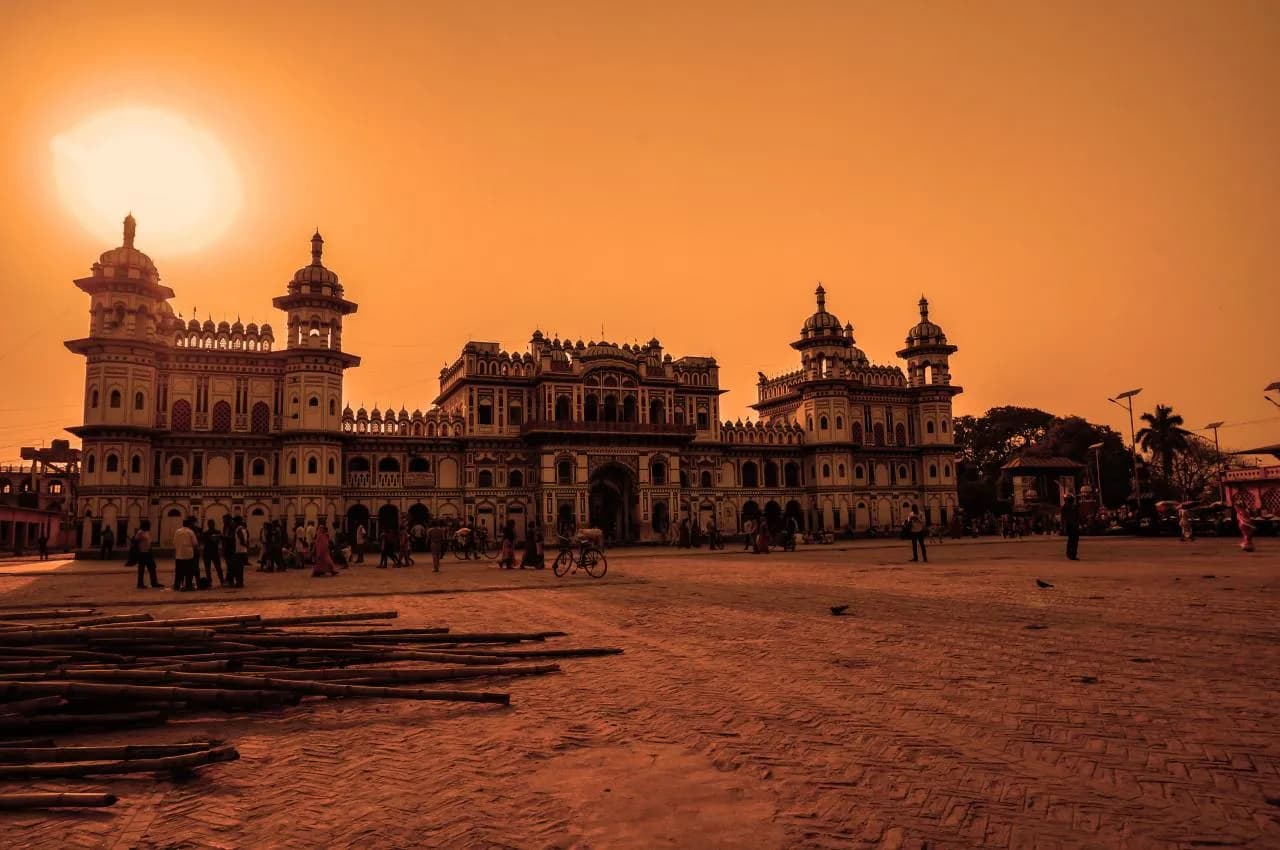
Janakpur Dham
Birthplace of Goddess Sita, site of the divine Ram-Janaki Vivah, and home to Janaki Mandir — Nepal's largest and most ornate temple in the heart of Mithila.


About Janakpur Dham
Janakpur Dham is one of the holiest pilgrimage destinations in Nepal and a site of immense significance in the Hindu tradition. Revered as the birthplace of Goddess Sita (Janaki) and the sacred site where Lord Ram and Sita were married in the divine Vivah ceremony, Janakpur holds a central place in the Ramayana narrative. For millions of devotees across South Asia, a pilgrimage to Janakpur completes the Ram-Sita sacred circuit.
The crown jewel of Janakpur is the magnificent Janaki Mandir — Nepal's largest temple. Spanning 1,480 square meters with 60 rooms across three stories, this white marble masterpiece blends Rajput, Mughal, and Hindu architectural styles. Built in 1910 by Queen Vrisha Bhanu of Tikamgarh (Madhya Pradesh, India) at a cost of 900,000 gold coins, the temple houses a golden idol of Goddess Sita and features stunning Madhubani wall paintings, colored glass windows, and intricately carved marble arches.
Janakpur was the capital of the ancient Mithila Kingdom, ruled by the legendary King Janak — a philosopher-king renowned for his wisdom and devotion. It was during a sacred plowing ritual (yajna) that King Janak discovered the infant Sita in a furrow of the earth, and it was here that Prince Ram broke Shiva's divine bow Pinaka in the Swayamvar to win Sita's hand in marriage.
Beyond its religious significance, Janakpur is the cultural capital of the Mithila region. The Maithili language, Madhubani art (GI-tagged in 2007, UNESCO-acknowledged), vibrant festivals, and living traditions of music and dance make it a window into one of South Asia's richest cultural heritages. The Janakpur Women's Development Centre preserves and promotes this artistic legacy through authentic Madhubani paintings.
Modern connectivity has made Janakpur increasingly accessible. Janakpur Airport offers 25-minute flights from Kathmandu, and the historic Jayanagar-Janakpur railway — reopened in 2022 with inauguration by PM Modi and PM Deuba — provides direct rail access from India. The consecration of Ram Mandir in Ayodhya (2024) has further boosted the Ayodhya-Janakpur cross-border pilgrimage circuit, making Janakpur a natural continuation of the Ram-Sita devotional journey.
Why Visit Janakpur Dham
 Birthplace of Goddess Sita — one of Hinduism's most revered devis, born from the earth during King Janak's sacred yajna
- Janaki Mandir — Nepal's largest and most ornate temple, a stunning white marble masterpiece of Rajput-Mughal-Hindu architecture with 60 rooms
- Vivah Panchami — witness the grand reenactment of the divine Ram-Sita marriage with over 300,000 pilgrims each year
- Mithila art and culture — experience authentic Madhubani paintings (GI-tagged), Maithili language, and vibrant living cultural traditions
- Ayodhya-Janakpur pilgrimage — complete the Ram-Sita sacred circuit, especially significant after the Ram Mandir Ayodhya consecration (2024)
- 72 sacred ponds — bathe at Dhanush Sagar, Ganga Sagar, and dozens of ancient ceremonial water bodies across the city
- Dhanushadham (18 km) — visit the site where the broken pieces of Shiva's divine bow Pinaka fell after Ram shattered it
- Easy access from India — visa-free entry for Indians, direct railway from Jayanagar, and flights from Kathmandu
History & Mythology
The history of Janakpur stretches back to the ancient Mithila Kingdom, one of the most celebrated kingdoms in Hindu scripture. King Janak (Seeradhwaja), a philosopher-king famed for his wisdom and spiritual mastery, ruled from this city. According to the Ramayana, while performing a sacred plowing ritual to end a drought, King Janak discovered an infant girl in a furrow of the earth. Named Sita (meaning "furrow"), this divine child grew up to become one of Hinduism's most revered goddesses — an incarnation of Lakshmi, the embodiment of virtue, devotion, and feminine strength.
The pivotal event in Janakpur's mythological history is the Swayamvar of Sita. King Janak declared that whoever could string Shiva's divine bow Pinaka would win his daughter's hand. Mighty kings from across the land could not even lift the celestial weapon. Prince Ram of Ayodhya not only lifted the bow but broke it in two with divine ease, winning Sita's hand and fulfilling cosmic destiny. The Vivah (marriage) ceremony that followed — performed with full Vedic rites around the sacred fire — is celebrated to this day during the Vivah Panchami festival.
The modern spiritual landmark of Janakpur, Janaki Mandir, has its own remarkable origin story. In 1657, a golden statue of Goddess Sita was discovered at the current temple site, establishing it as a place of active worship. The grand temple visible today was constructed beginning in 1910, commissioned by Queen Vrisha Bhanu of Tikamgarh (Madhya Pradesh, India) at a cost of 900,000 gold coins. The three-storied white marble structure, designed in the Koiri Hindu style blending Rajput, Mughal, and Hindu architectural elements, took several years to complete and stands as Nepal's largest temple.
In the modern era, Janakpur has faced both challenges and renewal. The 2015 earthquake caused damage to several historic structures, followed by careful restoration. A transformative moment came in 2022 when the historic Jayanagar-Janakpur railway was reopened, inaugurated jointly by Indian PM Modi and Nepali PM Deuba — reconnecting the cross-border pilgrimage route severed decades earlier. The consecration of Ram Mandir in Ayodhya in January 2024 has dramatically boosted pilgrimage traffic, with devotees naturally extending their journey to Janakpur to complete the Ram-Sita circuit.
Historical Timeline
Mithila Kingdom & Sita's Birth
King Janak rules the Mithila Kingdom from Janakpur. During a sacred plowing ritual, he discovers the infant Sita in a furrow of the earth.
Ram-Sita Swayamvar & Vivah
Prince Ram breaks Shiva's divine bow Pinaka in the Swayamvar, winning Sita's hand. The celestial Vedic marriage ceremony takes place in Janakpur.
Golden Sita Statue Discovered
A golden statue of Goddess Sita is discovered at the site of present-day Janaki Mandir, establishing it as a major pilgrimage site.
Janaki Mandir Construction Begins
Queen Vrisha Bhanu of Tikamgarh commissions the grand marble temple at a cost of 900,000 gold coins, blending Rajput-Mughal-Hindu architecture.
Jayanagar-Janakpur Railway Reopened
The historic cross-border railway is reopened, jointly inaugurated by PM Modi and PM Deuba, reconnecting the India-Nepal pilgrimage route.
Mythology & Legends
Sita's Birth from the Earth
During a sacred plowing ritual to end a drought, King Janak of Mithila discovered an infant girl in a furrow of the earth. Named Sita (meaning 'furrow'), she was ayonija — of divine, not mortal birth. Sita is revered as an incarnation of Goddess Lakshmi, born from Bhoomidevi (Mother Earth) herself.
The Swayamvar — Ram Breaks the Bow
King Janak declared that whoever could string Shiva's divine bow Pinaka would win Sita's hand in marriage. Mighty kings from across the land failed to even lift the celestial weapon. Prince Ram of Ayodhya lifted it with ease and broke it in two, sending shockwaves through the heavens and winning Sita's heart.
Ram-Janaki Vivah — The Divine Marriage
On Panchami of the Margashirsha month, Ram and Sita were united in a sacred Vedic marriage ceremony. The saptapadi (seven sacred steps) around the holy fire, the kanyadaan by King Janak, and blessings from sages made it the most celebrated divine wedding in Hindu tradition.
Sita's Return to Mother Earth
Born from the earth in Janakpur, Sita's story comes full circle when she ultimately returns to Mother Earth (Bhoomidevi) at the end of the Ramayana. The earth opens to receive her back, completing the divine cycle of the goddess who emerged from a furrow and returned to her origin.
Sacred Rituals & Practices
Key Attractions

Janaki Mandir
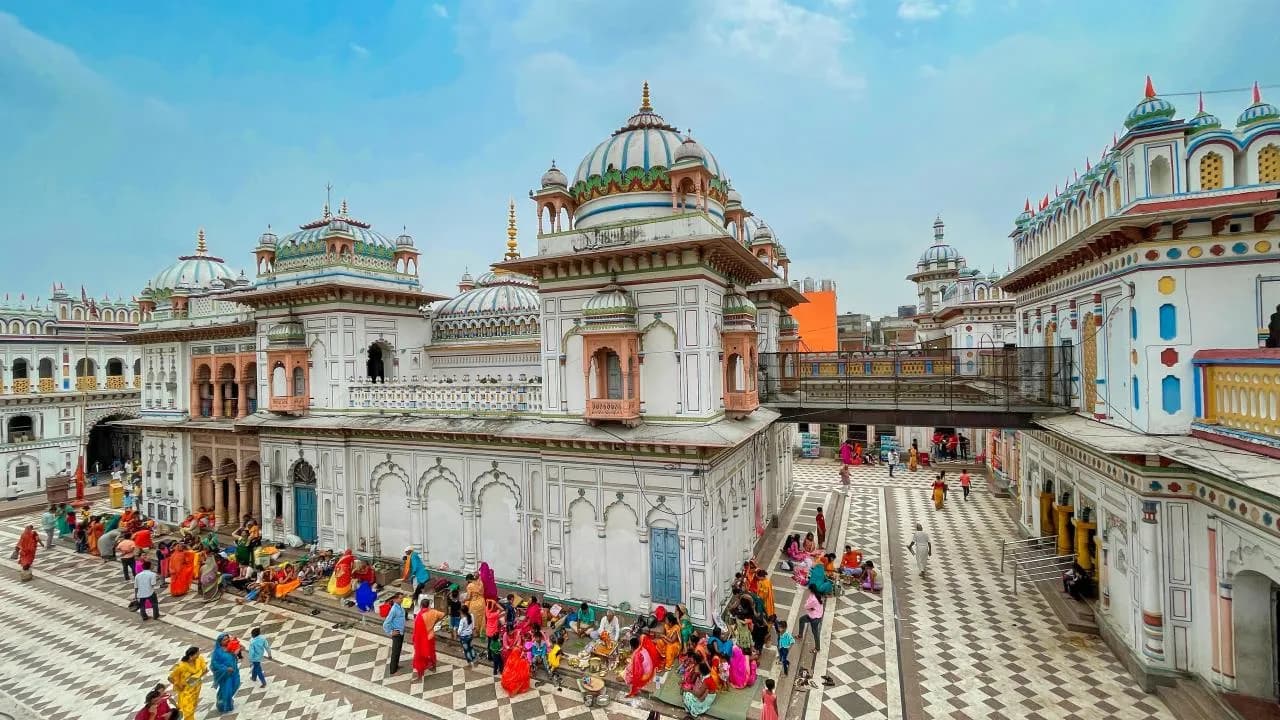
Nepal's largest and most ornate temple — a three-storied white marble masterpiece spanning 1,480 square meters with 60 rooms. Built in 1910 by Queen Vrisha Bhanu of Tikamgarh, the temple blends Rajput, Mughal, and Hindu architectural styles. Inside, the golden idol of Goddess Sita is surrounded by stunning Madhubani wall paintings, colored glass windows, and intricately carved marble arches and domes. The temple's sheer scale and craftsmanship make it one of Nepal's most impressive religious structures.
Vivah Mandap
A beautiful marble pavilion southwest of Janaki Mandir, marking the exact site where Ram and Sita's divine marriage ceremony took place. Adorned with pillars, arches, and domes, the mandap features sculptural depictions of the marriage scene. During Vivah Panchami, the grand reenactment of the wedding ceremony takes place here, drawing hundreds of thousands of pilgrims.
Ram Mandir
The oldest temple in Janakpur, predating Janaki Mandir. This historic shrine dedicated to Lord Ram is a separate complex from Janaki Mandir and holds deep significance as the city's original sacred site. Devotees visit both temples to honor the divine couple together.
Dhanush Sagar
The largest sacred tank in Janakpur, believed to have been formed where Shiva's divine bow struck the ground after Ram broke it during the Swayamvar. The pond is surrounded by smaller temples and shrines, and ritual bathing here is considered especially auspicious before visiting Janaki Mandir.
Ganga Sagar
A sacred pond near Janak Mahal, believed to contain the essence of all holy waters. Pilgrims perform ritual bathing here before proceeding to the main temple. The evening aarti conducted at Ganga Sagar is a serene and devotional experience, with oil lamps reflected in the sacred waters.
Dhanushadham (18 km)
Located 18 km northeast of Janakpur, Dhanushadham marks the site where the broken pieces of Shiva's divine bow Pinaka fell after Ram shattered it. A fossilized fragment believed to be part of the bow is preserved here. The site is an essential extension of the Janakpur pilgrimage for devoted visitors.
Janakpur Women's Development Centre & Mithila Art
A community of approximately 40 women artists who create authentic Madhubani (Mithila) paintings — a GI-tagged art form with ancient origins in wall murals. The centre preserves this UNESCO-acknowledged tradition while empowering local women. Visitors can watch artists at work and purchase genuine Madhubani art directly, making it both a cultural experience and a meaningful souvenir stop.
Hindu & Buddhist Coexistence
Hindu Perspective
For Hindus, Janakpur Dham is among the most sacred tirthas — the birthplace of Goddess Sita and site of the divine Ram-Janaki Vivah, a cornerstone of the Ramayana narrative.
- Birthplace of Goddess Sita — incarnation of Lakshmi, embodiment of devotion, virtue, and feminine divine strength (Shakti)
- Site of Ram-Sita Vivah — the cosmic union of Vishnu (Ram) and Lakshmi (Sita), celebrated as the ideal divine marriage
- Sacred tirtha (pilgrimage site) with moksha-granting significance for devotees who visit with sincere devotion
- 72 sacred ponds sanctified by ancient sages, each with specific spiritual merit for ritual bathing
- Connection to Ayodhya — Janakpur and Ayodhya together form the complete Ram-Sita pilgrimage circuit
- Sita as Shakti archetype — represents the ideal of feminine divine power, sacrifice, and unwavering dharma
Buddhist Perspective
While Janakpur itself has limited direct Buddhist connection, it sits within the broader Terai sacred landscape that includes Lumbini (Buddha's birthplace, ~250 km west).
- Lumbini, birthplace of Lord Buddha, lies approximately 250 km west — both sites share the Terai sacred landscape
- Shared reverence for sacred feminine figures — Sita in Hinduism parallels the reverence for Maya Devi in Buddhism
- Historical Buddhist presence existed in the wider Mithila region during the medieval period
- Cross-pilgrimage between Janakpur and Lumbini is increasingly popular for visitors exploring Nepal's spiritual heritage
- Both traditions honor sacred geography and the concept of tirtha (places of spiritual crossing)
- The Sita Trail pilgrimage concept parallels established Buddhist pilgrimage circuits across South Asia
Shared Sacred Elements
- Both Hindu and Buddhist traditions honor the sacred geography of Nepal's Terai plains
- The concept of pilgrimage circuits is central to both — Janakpur-Ayodhya mirrors Lumbini-Bodh Gaya-Sarnath
- Shared cultural landscape: Maithili and Terai traditions encompass both Hindu and Buddhist heritage
- Cross-pilgrimage between Janakpur (Sita's birthplace) and Lumbini (Buddha's birthplace) is a growing practice
- Both sites share the reverence for divine feminine figures — Sita and Maya Devi
- Nepal's identity as a multi-faith pilgrimage destination is enriched by both Janakpur and Lumbini
Where Science Meets Faith
The phenomena at this sacred site have fascinated both scientists and devotees for centuries.
Archaeological Evidence at Janakpur
 Scientific Explanation
Excavations conducted in 2016 near Janaki Mandir uncovered pottery fragments dating to the 5th–6th century BCE, ancient ovens, tridents, and structural remains suggesting organized settlement. Earlier archaeological surveys indicate human habitation at the site dating back to at least 1000 BCE, consistent with the Mithila Kingdom period described in ancient texts. The layered deposits suggest continuous occupation over millennia.
 Spiritual Significance
These findings are seen by devotees as physical confirmation of the ancient Mithila Kingdom described in the Ramayana and other Vedic texts. The archaeological dating aligns with traditional accounts of King Janak's reign, reinforcing the belief that Janakpur is indeed the ancient capital where Sita was born and raised.
Janaki Mandir — Architectural Engineering
Scientific ExplanationThe temple is built in the Koiri Hindu architectural style, a fusion of Rajput, Mughal, and Hindu design traditions. The three-storied structure uses stone-and-marble construction techniques that achieved structural integrity without modern adhesives. The 1,480 sq m building withstood the 2015 Gorkha earthquake (7.8 magnitude), demonstrating the engineering resilience of its traditional construction methods, though it did sustain some damage requiring restoration.
Spiritual SignificanceThe temple's architecture is deliberately symbolic — its domes represent the cosmic mountain (Meru), its 60 rooms symbolize the expansiveness of divine creation, and the Madhubani paintings adorning the walls depict scenes from the Ramayana, connecting every visitor to the sacred narrative through art.
Mithila Art (Madhubani) — Living Heritage
Scientific ExplanationMadhubani art received Geographical Indication (GI) tagging in 2007 and UNESCO acknowledgment as an intangible cultural heritage. Originating from ancient wall murals, the transition from wall-to-paper in 1934 (after a devastating earthquake exposed the murals) and the 1989 paper-based innovation expanded the art form globally. The paintings use natural dyes extracted from plants and minerals, with geometric and figurative designs following strict iconographic traditions passed through generations of women artists.
Spiritual SignificanceMadhubani art is deeply ritualistic — traditionally painted on walls during weddings, festivals, and ceremonies. The Kohbar (bridal chamber) paintings depict lotus flowers, bamboo groves, fish, and parrots — all fertility symbols associated with the Ram-Sita marriage tradition. The art is not merely decorative but a spiritual practice connecting artists to divine narratives.
Terai Ecology & Sacred Water Systems
Scientific ExplanationJanakpur lies in Nepal's Terai region — alluvial plains with a humid subtropical climate (Köppen classification Cwa). The 72 ancient ponds scattered across the city represent a remarkable pre-modern water conservation system. Fed by monsoon rains and groundwater, these ponds served both sacred and practical purposes — water supply, flood control, and groundwater recharge. The fertile silt deposits from Terai rivers support some of Nepal's most productive agricultural land.
Spiritual SignificanceEach of the 72 ponds is associated with specific sacred narratives — Dhanush Sagar with Shiva's bow, Ganga Sagar with the essence of holy rivers. The ponds are seen as earthly manifestations of celestial water bodies, and ritual bathing in them is believed to purify the soul. This reverence has inadvertently preserved these water bodies for centuries.
How to Reach Janakpur Dham
Route Steps
Domestic terminal for Janakpur-bound flights
Short scenic flight over the Terai plains. Multiple daily flights by Buddha Air and Yeti Airlines.
Auto-rickshaw or taxi from the airport to the temple area
 Pros
Pros- Fastest option from Kathmandu
- Comfortable and scenic flight
- Multiple daily departures
- Flights can be cancelled due to weather or low visibility
- More expensive than bus (~USD 57 one-way)
- Limited luggage allowance
Best Time to Visit
Green-bordered months are the recommended times to visit.
January✓ Best
11°C to 24°C
10mm
Flights: Good
Cool and pleasant winter. Clear skies, comfortable daytime temperatures. Makar Sankranti celebrations. Uncrowded — excellent for peaceful darshan.
February✓ Best
13°C to 26°C
12mm
Flights: Good
Late winter. Warming up gradually. Clear visibility. Very pleasant for sightseeing and temple visits. Few tourists.
March✓ Best
18°C to 32°C
15mm
Flights: Good
Spring arrives. Ram Navami celebrations bring pilgrims. Temperatures rising but still comfortable in mornings and evenings.
April
22°C to 36°C
20mm
Flights: Good
Getting hot. Daytime temperatures uncomfortable. Sita Navami celebrations. Visit early morning or evening to avoid peak heat.
May
25°C to 38°C
40mm
Flights: Good
Very hot — temperatures can exceed 38°C. Pre-monsoon thunderstorms begin. Not recommended for comfort.
June
26°C to 36°C
150mm
Flights: Moderate
Monsoon begins. Heavy rainfall, humidity, mosquitoes. Flooding risk in low-lying areas. Avoid unless necessary.
July
26°C to 34°C
280mm
Flights: Poor
Peak monsoon. Heaviest rainfall month. Waterlogging and flooding common. Roads may be impassable. Strongly avoid.
August
26°C to 34°C
250mm
Flights: Poor
Monsoon continues. Humidity very high. Mosquito-borne illness risk highest. Not suitable for tourism.
September
25°C to 33°C
180mm
Flights: Moderate
Monsoon receding but still wet. Dashain preparations begin. Late September can be manageable.
October✓ Best
20°C to 32°C
40mm
Flights: Good
Post-monsoon — best season begins. Pleasant temperatures, clear skies. Dashain and Chhath Puja. Excellent time to visit.
November✓ Best
15°C to 28°C
5mm
Flights: Good
Peak season. Vivah Panchami (biggest festival) draws 300,000+ pilgrims. Perfect weather. Book well in advance.
December✓ Best
12°C to 24°C
5mm
Flights: Good
Cool and dry. Very pleasant daytime temperatures. Post-Vivah Panchami — fewer crowds. Excellent for comfortable pilgrimage.
Festival Calendar
Vivah Panchami
Janakpur's grandest festival — the spectacular reenactment of Ram-Sita's divine marriage. A grand Rangabhoomi procession carries idols through the streets to Vivah Mandap. Over 300,000 pilgrims from Nepal and India attend. Multi-day celebrations with music, devotional singing, and cultural programs.
Ram Navami
Celebration of Lord Ram's birthday. Over 100,000 pilgrims gather for ritual bathing of Ram's image in milk, sacred pond bathing, elephant processions, and special pujas at all major temples. A major pilgrimage event second only to Vivah Panchami.
Chhath Puja
Ancient 4-day Vedic festival dedicated to the Sun God, celebrated with extraordinary devotion at Dhanusha Sagar and sacred ponds. Women-centered, sattvic tradition involving 36-hour fasting and sunrise/sunset water oblations. One of the Terai's most visually stunning festivals.
Dashain
Nepal's biggest national festival celebrating the victory of good over evil (Goddess Durga over Mahishasura). Community celebrations, family gatherings, and special pujas at temples throughout Janakpur.
Tihar / Diwali
Festival of lights with special significance in Janakpur given Sita's identity as an incarnation of Goddess Lakshmi. Oil lamps illuminate temples and homes. Rangoli art and Mithila wall paintings are renewed.
Makar Sankranti
Harvest festival marking the sun's northward journey. Celebrated with sacred pond bathing, kite flying, and preparation of seasonal delicacies. A joyful winter celebration with community feasting and cultural programs.
Altitude Sickness Guide
Janakpur is located at just 77 meters (253 feet) above sea level in Nepal's Terai plains — there are absolutely no altitude concerns. The main health considerations are heat (April–June can exceed 40°C), monsoon-related issues (June–September: flooding, waterborne diseases, mosquitoes), and sun exposure. Visitors from hill regions may find the heat challenging in summer months.
Symptoms to Watch
 Heat exhaustion and heat stroke risk in summer months (April–June)
- Dehydration from high temperatures and humidity
- Mosquito-borne illness risk (dengue, malaria) especially in monsoon season
- Waterborne disease risk from contaminated water during monsoon
- Sunburn and sun exposure risk in open temple areas
- Digestive issues from unfamiliar food or water
Prevention Tips
- Stay well hydrated — drink 3-4 liters of purified water daily, especially in summer
- Use sun protection — hat, sunscreen SPF 50+, sunglasses, and seek shade during midday
- Apply mosquito repellent (DEET-based) and use mosquito nets at night during monsoon
- Drink only purified or bottled water — carry ORS (Oral Rehydration Solution) packets
- Wear light, breathable cotton clothing to manage heat and humidity
- Visit temples during early morning or evening to avoid peak heat hours
- Carry basic medications: anti-diarrheal, antihistamine, pain relievers, and anti-nausea
Acclimatization Schedule
| Day | Activity | Altitude |
|---|---|---|
| Day 1 | Arrive in Janakpur. Rest during afternoon heat. Explore temple area in the cool evening. Evening aarti at Janaki Mandir. | 77m |
| Day 2 | Morning darshan at Janaki Mandir (6:30 AM aarti). Visit Vivah Mandap, Ram Mandir, and sacred ponds. Rest during midday heat. | 77m |
| Day 3 | Day trip to Dhanushadham (18 km). Visit Janakpur Women's Development Centre. Explore Mithila art and local markets. | 77m |
Accommodation Guide
Basic hotels and dharamshalas near the Janaki Mandir temple area. Simple rooms with essential amenities for pilgrims on a budget.
Temple-area Dharamshalas
NPR 500–1,000/nightNear Janaki Mandir
Hotel Rama
NPR 1,100–1,500/nightStation Road
Hotel Welcome
NPR 1,200–2,000/nightNear Bus Park
Food & Cuisine Guide
Dal Bhat
VegNPR 150–300Nepal's staple meal — lentil soup with rice, seasonal vegetables, pickles, and chutney. Unlimited refills at most eateries. The foundation of every Nepali meal and perfect sustenance for pilgrims.
Thekua
VegNPR 50–100Iconic Mithila sweet made from wheat flour, jaggery, and ghee, deep-fried to a crunchy golden finish. A signature Chhath Puja offering and year-round Janakpur specialty. Must-try for every visitor.
Dal Pitha
VegNPR 80–150Traditional Mithila dumplings — rice flour parcels stuffed with spiced lentil filling, steamed or fried. A comfort food deeply rooted in Maithili cuisine and available at local eateries near the temple.
Makhana Kheer
VegNPR 100–200Rich dessert made from lotus seeds (makhana) cooked in sweetened milk with cardamom and nuts. Makhana is a regional specialty harvested from the Terai wetlands. Creamy, fragrant, and uniquely Mithila.
Fish Curry
Non-VegNPR 200–400Fresh river fish cooked in a spiced mustard-based curry — a staple of Mithila non-vegetarian cuisine. Available at restaurants away from the temple area. A must-try for non-vegetarian visitors.
Sattvic Vegetarian Thali
VegNPR 100–250Pure vegetarian meal without onion or garlic, prepared in the traditional sattvic style ideal for pilgrims observing dietary restrictions. Available at temple-area eateries and dharamshalas.
Sel Roti
VegNPR 30–60Traditional ring-shaped rice flour bread, deep-fried to a crispy golden texture. Popular during festivals, especially Tihar and Chhath. Often served with yogurt or vegetable curry for breakfast.
Dahi Chura
VegNPR 50–100Beaten rice (chura) mixed with fresh yogurt, sugar, and seasonal fruits. A light, refreshing breakfast or snack commonly eaten in the Terai region, especially during festivals and celebrations.
Restaurant Types
Simple vegetarian restaurants and stalls near Janaki Mandir serving dal bhat, thali meals, and sattvic food. The most convenient option for pilgrims. Pure vegetarian with no onion/garlic options available.
Mid-range restaurants in central Janakpur offering multi-cuisine menus including Indian, Nepali, Chinese, and Mithila specialties. Better ambiance and wider food options than temple-area eateries.
Restaurant facilities in hotels offering the widest menu variety including continental breakfast, Indian thali, and regional specialties. Best option for comfort and hygiene-conscious travelers.
Food Tips
- Try thekua and dal pitha — the signature Mithila dishes you won't find easily elsewhere
- Vegetarian food is abundant near the temple area — sattvic (no onion/garlic) options available during festivals
- Fresh makhana (lotus seeds) is a regional specialty — buy some as a healthy, shelf-stable souvenir
- Drink only purified or bottled water — avoid tap water and ice in drinks
- Street food is tempting but stick to freshly prepared items from busy stalls for food safety
- During Chhath Puja, special thekua and seasonal sweets are available throughout the city
- Carry light snacks and water for the Dhanushadham day trip — options are limited en route
- Most temple-area restaurants close by 9 PM — plan dinner accordingly
Budget & Cost Guide
| Category | Budget | Mid-Range | Premium |
|---|---|---|---|
| Transport (to Janakpur) | Bus from KTM or border | Flight from KTM | Flight + private car |
| Food (per day) | Temple-area eateries | City restaurants | Hotel dining |
| Accommodation (per night) | Dharamshala / basic hotel | AC hotel | Best available hotel |
| Puja Items & Offerings | Basic flowers & sweets | Full puja set | Elaborate puja with priest |
| Local Transport | Cycle-rickshaw / walking | Auto-rickshaw | Private car / taxi |
| Miscellaneous | Minimal extras | Mithila art souvenirs | All comforts + art shopping |
| Daily Total | Very Affordable | Comfortable & Good Value | Best Available Experience |
Budget
Very Affordable / dayMid-Range
Comfortable & Good Value / dayPremium
Best Available Experience / dayPacking Checklist
Clothing
| Essential | Additional |
|---|---|
| Light cotton clothing (loose-fitting) | Light jacket (for winter mornings, Nov–Feb) |
| Comfortable walking shoes or sandals | Rain gear / umbrella (monsoon — though visit not recommended) |
| Sun hat or cap | |
| Shawl or dupatta for temple visits | |
| Modest clothing for temples (covers shoulders and knees) | |
| Change of clothes for sacred pond bathing |
Health & Protection
| Essential | Additional |
|---|---|
| Sunscreen SPF 50+ | Anti-diarrheal and anti-nausea medication |
| Mosquito repellent (DEET-based) | Antihistamine for insect bites |
| Reusable water bottle with purifier | |
| ORS (Oral Rehydration Solution) packets | |
| Basic first aid kit | |
| Personal medications |
Temple & Spiritual
| Essential | Additional |
|---|---|
| Modest clothing for darshan | Offerings (flowers, fruits — available at temple shops) |
| Small towel for sacred pond bathing | Prayer beads (mala) if desired |
| Vermillion and sacred thread if applicable |
Documents & Electronics
| Essential | Additional |
|---|---|
| Valid photo ID (Aadhaar/Voter ID for Indians, Passport for others) | Camera |
| Phone with Nepal SIM or roaming data | |
| Power bank (10,000mAh+) | |
| Cash — NPR preferred; INR ₹100 notes accepted near border | |
| Copies of all documents (digital + physical) |
Specialized Guides
Safety is Good
Janakpur is generally safe for women travelers. The temple area is well-visited and local communities are welcoming. Standard precautions apply — travel with companions if possible, especially after dark.
Dress Modestly at Temples
Cover shoulders and knees at Janaki Mandir and other temples. A dupatta or shawl is recommended. Modest clothing is also culturally respectful in the conservative Mithila region.
Chhath Puja is Women-Centered
If visiting during Chhath Puja (Oct/Nov), women play the central role in this festival. It's a deeply empowering experience to witness — women lead the fasting, rituals, and offerings.
Sacred Pond Bathing
Separate bathing areas or times may be available at sacred ponds. Wear a salwar kameez or full-coverage clothing for bathing. Carry a large shawl or towel for privacy.
Health Essentials
Carry personal hygiene products as availability can be limited. Mosquito repellent is essential. Sunscreen and a hat protect against the strong Terai sun.
Photo Gallery
Nearby Attractions
Dhanushadham
18 km NESacred site where the broken pieces of Shiva's divine bow Pinaka fell after Ram shattered it during the Swayamvar. A fossilized fragment believed to be part of the bow is preserved here. Essential extension of the Janakpur pilgrimage.
Jaleshwar
45 km SEHome to one of Nepal's oldest and most important Shiva temples — Jaleshwar Mahadev. An ancient pilgrimage site with deep historical roots, easily combined with a Janakpur visit for a comprehensive Terai sacred tour.
Sitamarhi, Bihar (India)
45 km via borderThe Indian town claiming to be Sita's birthplace, with the famous Sita Kund and temples. Cross-border pilgrimage combining both Sita-related sites is popular. Indian nationals can cross freely with valid photo ID.
Lumbini
~250 km WBirthplace of Lord Buddha and UNESCO World Heritage Site. The Mayadevi Temple, Ashoka Pillar, and international monasteries make this a must-visit. Combine with Janakpur for Nepal's two greatest pilgrimage destinations.
Chitwan National Park
~100 km WNepal's premier wildlife destination — home to one-horned rhinoceros, Bengal tigers, and over 500 bird species. A perfect contrast to the spiritual intensity of Janakpur. Jungle safari, elephant encounters, and Tharu cultural shows.
Frequently Asked Questions
Yes, according to Hindu tradition and the Ramayana, Janakpur (ancient Mithila) is the birthplace of Goddess Sita. King Janak of Mithila discovered the infant Sita in a furrow of the earth during a sacred plowing ritual. Janakpur is revered as the place where Sita grew up and where her Swayamvar and marriage to Lord Ram took place. Archaeological evidence supports ancient settlement here dating back to at least the 5th-6th century BCE.
The easiest way is by train from Jayanagar, Bihar — the Jayanagar-Janakpur railway was reopened in 2022 with 4 daily trains (~1.5 hrs). Alternatively, drive from Sitamarhi to the Bhittamore-Jaleswar border crossing (45 km, ~1 hr). Indian nationals don't need a visa — free entry with valid photo ID (Aadhaar, Voter ID, or Passport). INR ₹100 notes are accepted near the border area.
Vivah Panchami is the grand annual celebration of the divine marriage of Lord Ram and Goddess Sita. It falls on Panchami of the Shukla Paksha of Margashirsha month (November/December). The festival features a spectacular reenactment of the wedding ceremony at Vivah Mandap, a grand Rangabhoomi procession, and multi-day celebrations drawing over 300,000 pilgrims from Nepal and India.
October to December is the best period — pleasant weather (12-28°C), clear skies, and major festivals including Chhath Puja and Vivah Panchami. January-February is also good (cool, uncrowded). March is pleasant with Ram Navami celebrations. Avoid April-September: extreme heat (35-40°C) in summer and heavy monsoon flooding in June-September.
2-3 days is ideal. Day 1: Janaki Mandir darshan, Vivah Mandap, Ram Mandir, and sacred pond visits. Day 2: Dhanushadham day trip (18 km), Janakpur Women's Development Centre, and Mithila art exploration. Day 3 (optional): Deeper exploration of the 72 sacred ponds, local markets, and cultural experiences. During Vivah Panchami, add an extra day for the festivities.
Absolutely — this is one of the most meaningful Hindu pilgrimage circuits. After visiting Ram Mandir in Ayodhya, travel to Janakpur to visit Sita's birthplace and the site of their divine marriage. Route: Ayodhya → Gorakhpur → Sonauli border → bus/vehicle to Janakpur. Or Ayodhya → Sitamarhi → Bhittamore border → Janakpur. The Jayanagar-Janakpur railway makes the India connection especially convenient.
Yes, Janakpur is very safe for Indian tourists. The city has deep cultural and linguistic connections with Bihar and eastern UP — many locals speak Hindi and Maithili. Indians don't need a visa (free entry with photo ID). INR is accepted in border areas. The local community is extremely welcoming to Indian pilgrims, especially during Vivah Panchami and other major festivals.
Dress modestly — cover shoulders and knees. For women, salwar kameez with dupatta is ideal. For men, long pants and a shirt. Remove shoes before entering the temple. If you plan to bathe at sacred ponds, carry a change of clothes and a towel. Avoid leather items inside the temple complex. During winter (Nov-Feb), carry a light jacket for early morning aarti.
Photography is generally allowed in the outer courtyard and exterior areas of Janaki Mandir. However, photography inside the main sanctum (garbhagriha) may be restricted, especially during aarti and puja. Always ask for permission before photographing people or specific rituals. Video recording may have additional restrictions. Respect any signage or instructions from temple staff.
Janakpur offers excellent vegetarian and non-vegetarian food. Near the temple: pure vegetarian eateries serving dal bhat, thali, and sattvic meals. Must-try Mithila specialties: thekua (jaggery-wheat sweet biscuit), dal pitha (lentil dumplings), makhana kheer (lotus seed dessert), and sel roti. Fresh makhana (lotus seeds) is a local delicacy. City restaurants offer Indian, Nepali, and Chinese cuisine. Drink only purified water.